Out
Patient Services are essential for the community. Government
staff hospitals but clinics are NGO run
Hope Clinic's out-patients department works with
partners to reduce the barriers that the community could
face. The bad STICK is replaced through a strong referrals
network using hosted
referrals so that the service comes
to Lukuli, not with the patient told to go elsewhere.
The whole system is client focussed, comprehensive and
caring.
Stigma
is replaced by Support - the working
together of partners means we can serve the community
with the services they need, and seek, and do so in a
low stigma, non-judgmental setting. We partner with the
Kampala City clinic which provides immunisation vaccines
so that we can ensure good coverage for under-5s. Through
partnerships with Right to Play we have youth information
games and Straight Talk work with the teenagers.
Time
to travel is reduced with hosted referrals. Through Training
our staff think not only about one service but integrate
child immunisation with growth development advice, with
family planning choices, nutrition recommendations and
counselling information for HIV. Very few organisations
have experienced local capacity development to offer general
health services integrated to a comprehensive HIV and
AIDS service. We have over five years of community systems
strengthening with government, CBO, women's groups and
individuals working together. Our partnerships include
UNITAID, the Global Fund, CHAI and PEPFAR through their
commodities we stock.
Inertia
can halt any action by the client. Our Infrastructure
of partners is a key strength that the OPD and
the other clinic services have developed and maintain.
The NGO
Facility allows access to centrally procured commodities
and as affiliates to the UPMB
we are a Health Centre III and access malaria ACTs and
Essential Drugs from Joint Medical Stores. We partner
with the UNFPA to access family planning products. We
are a Good Life Clinic in the UHMG network through whom
we access client service materials (including signage)
and HIV test kits. We provide reports to each of our partners
ensuring 'information for decision making' is identified,
recorded and used.
Cost remains the biggest barrier to accessing
health. Whether travel costs, opportunity cost of being
away from work or the fees and unpublished 'access charges'
to see the medic or receive the tests at some for-profit
sites. Government sites are over-run and cannot serve
the clients in terms of equipment, space or time per patient.
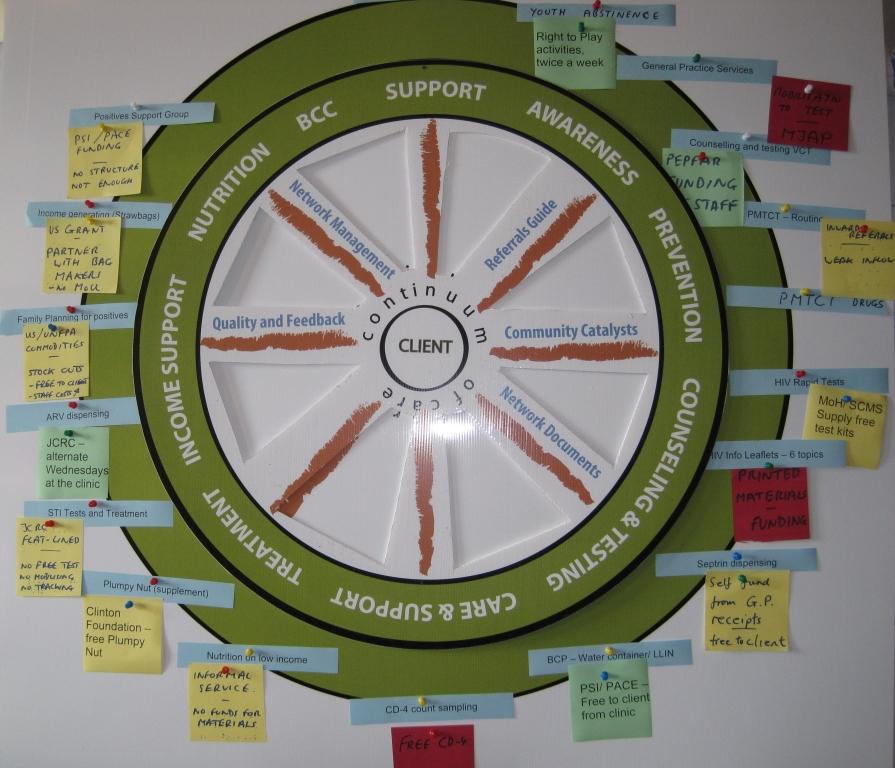
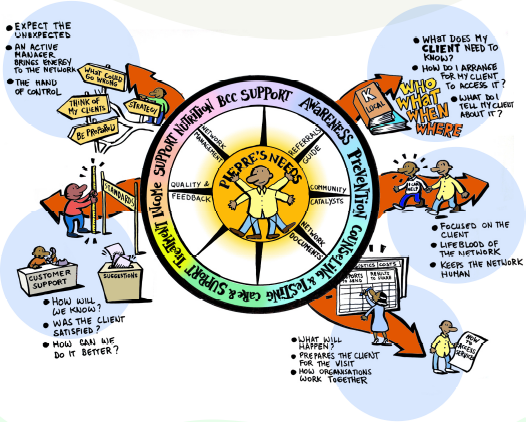
A key part of the hosted referrals model are Community
Catalysts. These are clinic staff who manage
outreaches to deliver services or mobilise clients, but
also volunteers, other health service providers, religious
leaders and our expanding customer base who motivate the
community to learn their human rights for health and to
access the services. With TextToChange
we used mHealth to support our Catalysts in their work.
Knowledge
is not as Lacking as it was. Not knowing that
services exist, not realising diet affects strength affects
resistance to illness and affects growth means the demand
for health services was low. Hope Clinic Lukuli works
with partners to offer the services, through Catalysts
we mobilise the community and through Affordable Medical
Treatment From Good and Friendly Staff we reduce the other
barriers.
The
good STICK: Support Training Infrastructure Catalysts
Knowledge was developed by Hope Clinic Lukuli
and through the PEPFAR New Partners Initiative was taken
to other NGO in other countries. In Lukuli, the referrals
network is maintained by the active engagement with partners
by the 'network manager' and that means we balance the
clients' needs and the need for our continued ability
to serve their needs.
Sustainability
for a local indigenous organisation is about using the
existing technical skills of the staff and community to
build partnerships and through those local capacity is
developed to keep serving. It is not simply financial
self-sufficiency as each country - whether Canada, USA,
UK, South Africa or Uganda - has a population who don't
have the incomes to buy the health services they need.
In some countries the necessary safety net is called a
National Health Service, in the developing world the reliance
is on support from development partners. For Lukuli, Hope
Clinic's partnerships with government and development
partner programmes means we are the safety net. The nearest
government staffed facilities is 3 miles (5km) away, the
nearest (private) hospital is 2 miles in the opposite
direction. Makindye Division Health Department recognise
our partnership role to meet local health needs.
 |
 |
 |
|
Not for Profit - For the Community |
Our range of services meet clients'
needs |
Hosted Referrals - client at
the core |
Hope
Clinic Lukuli's Hosted Referrals concept was expanded
to detail the bad stick, good stick, and the wheel for
mapping client service needs by the Director and co-founder
of Hope Clinic whilst he was Project Director of a technical
assistance team. This and production of these graphics
was funded by the US Centers for Disease Control and Prevention
(CDC). Project site
The concept has now been adopted with other NGO in East
and Southern Africa.